Saturday, March 26, 2011

Mini Matcha Bunny Cakes

Easy as pie(which isn't actually that easy to make, so... easier than pie?), tasty, and cute.

Preheat oven to 250 degrees.

In a large bowl mix 1c. flour, 1/3c. sugar, 3/4 Tbsp. industrial/cooking grade matcha, 1 tsp. soy butter, and 1c. hot water together into a green and slightly runny batter.

Spray the cooking pan or mold(s) of your choice(I obviously went with bunnies) with non-stick spray, then pour the batter in, distributing evenly if using more than one pan/mold. I used three at a time.

Bake for 20-30 minutes, give or take for your oven, do the 'fork test'(stick it in to see if it comes out clean) to test if they're finished.

When done, remove from the oven and let cool before removing them from the pan/mold.

Enjoy plain, or with a light sprinkling of powdered sugar, and a cup of hot sencha!

Thursday, March 24, 2011

The Green Stuff

I said before I would post a picture of the new chawan with matcha in it, so here it is with some of Den's Tea's Matcha Kaze. Not the best matcha on the market, but for usucha(thin matcha) I can't complain.

I considered making this out into a post about how to prepare matcha, but then I noticed that Tales of Japanese Tea, Kohei, had posted a rather lovely video that covers pretty much everything you'd want to know about matcha preparation*, so I'll just link to him instead. ;p

*Well, for usucha. This is roughly how I prepare it, two scoops with 60ml of water. For koicha(thick matcha) you need both more scoops/less water as well as a higher quality matcha.

Sunday, March 20, 2011

Friday, March 18, 2011

Large Leaf from Old Trees Pu' erh

Got this as a sample from Chicago Tea Garden and it's nearly everything I like in a pu'erh.

The description:
"This pu-erh is made from the large leaves of old tea trees. It is aged in loose form, so there is no need to purchase a large cake. This tea is bold and earthy, with a smooth, sweet, lingering aftertaste. These leaves have been aging in a man-made pu-erh cave in the United States since the mid-90s."

It's got a strong earthy aroma and the brew, from the very first steep, has this rich, old flavor to match.

Took about half of the sample in a 160ml pot filled to ~100ml, think I'll see if it brews differently in a gaiwan for the latter half. Used water ranging from 205 to 195, the hotter producing stronger/shorter/darker brews, and poured into a ~140ml cup.

The only downfall was the longevity of the leaves, only about a day's worth of brewing and faster to require long steeps than other pu'erh I've encountered. Depending on your taste, there was a bit of dustiness to the first steep or so, even after having been rinsed. Also, I couldn't find any of the bitterness I've read about it in some reviews, and only ever got a little sweet around the fourth brew. Not sure if the lack of bitter is a pro or con for me, but the sweet was pleasant while it lasted.

Along with this and the Zealong Pure, I also received a sample of their Wu yu and the Camel's Breath Toucha. Have only gotten around to the Wu yu so far, but definitely enjoyed it. My first impression was that it tasted a little closer to a Japanese green than a Chinese, though as it progressed it grew more into that familiar Chinese green taste. Might order some eventually(newer harvest?), but for now my curiosity is sated.

Edit: Oh! And I've been repurposing decor/gardening things lately for my tea time. See: the candle stand that I found just the right size for a pot.

Thursday, March 17, 2011

Kimchi Jjigae(김치찌개)

This is, in short, a soup/stew made using kimchi. It's very spicy and very delicious. Also, pretty easy to make.

Take a medium-sized pot and pour a little oil on the bottom and put over medium-high heat. Mince some garlic, chop some scallions(and maybe mushrooms and matchstick chop daikon), and cut about a half a block of tofu into one inch squares.

Toss all these things into the pot. While they cook, chop one-two cups of kimchi and, when done add it to the pot.

Use a fork/spoon/chopsticks to shift the items in the pot so nothing gets overcooked then, about a minute after adding the kimchi, add enough water to cover everything and either a dab of gouchujang(if the kimchi is new) or a quarter cup of kochukaru(for older kimchi). Bring it to a boil, stirring on occasion, then lower the heat and let simmer for 20 minutes to an hour.

If the water gets low, feel free to add more. Once done, I tend to add some fresh scallions on top and a pinch more of kochukaru. Serve with plain white rice and a little soy sauce to taste.

I tend to drink hot water with this, and most spicy foods, rather than tea. Hot, because that's how I drink it and it seems to work better than cold for spicy, and water because tea would be wasted to drink with this since you won't be able to taste it. ;p

Sunday, March 13, 2011

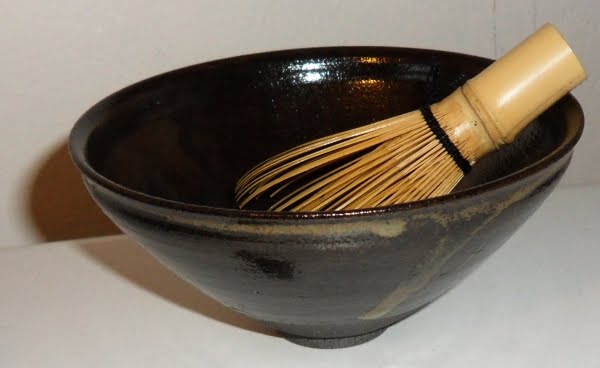
New Chawan

Bought from MarshalN off TeaChat.
Quite pleased with it, so a quick photo following some matcha. Will likely post another photo, pre-drinking, sometime soon. Love the way matcha looks in it.

Zealong Pure

...and bunnies.

Zealong is oolong grown in New Zealand. I think I'd also like to try the Aromatic and Dark varieties, though for now I tried Pure, it having the most appealing description.

Used 195-200 degree water and about a third of the sample, from Chicago Tea Garden, in a 160ml gaiwan. The first ten steeps were rapid, pouring the water in then pouring it into the cup within a few seconds. Despite the speed, the first three steeps tasted a bit too strong, far too buttery with an astringent undertone.

However, once over that bump, it was rather delicious. Still buttery, though with a bit of a sweet floral note to it and a lovely scent to match.

So, it seems, New Zealand makes a pretty decent oolong. I'd recommend it.

That settled, for the curious, how the tea came to New Zealong:

"Zealong was established in 1996 in Rototuna, Hamilton, when its founder, Vincent Chen, brought 1500 seedlings from Taiwan. The Ministry of Agriculture and Forestry/Biosecurity New Zealand (MAFBNZ), being one of the strictest in the world, quarantined the seedlings for 10 months. Only 130 of the strongest seedlings survived, and these were planted in New Zealand. Today, one million tea plants are harvested by hand three times per year, on a 120 acre farm in Gordonton."